

(Originally posted: 3/17/2013)
Last week, I was teaching kinship systems in my cultural anthropology class, and as usual students were as interested in learning how our own kinship system works as they were in learning the systems used by other cultures. Everyone is pretty clear on grandparents and great-grandparents, but the cousins are confusing. It seems that, in the last few generations, Westerners have become increasingly haphazard in teaching their children how cousins work. Everyone knows that there are second cousins who are closer to you than third cousins, and everyone knows that there’s something about “once removed” and so on, but very few people seem to really understand how to calculate these things anymore. So, as a public service, I thought I’d explain it all. Click through for the full story.
First, I’ll make the caveat that the system I’m describing here is the one that I learned through a combination of talking to older relatives and reading up. I’ll make no promises that there isn’t some regional variation where usage is different. But this system seems to work well enough in most circumstances, and it’s easy to understand.
We’ll start by noting that the Western system is bilateral. It applies equally well to both the mother’s and father’s side of the family, and the genders of the individuals usually doesn’t matter. Because of that, I’ll be using squares in the kinship diagrams–triangles would indicate males, and circles would indicate females, but squares indicate “either.”
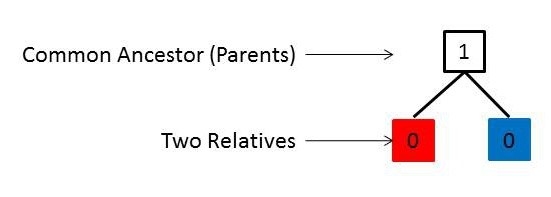
Any two relatives share a common ancestor in the last few generations (obviously). The only relationships that matter for calculating relatedness in our system are the two chains of child-to-parent relationships from the individuals to the common ancestor. The simplest circumstance is when each chain has only one link–that is, the common ancestor is a parent. These two relatives are called “siblings.”
When the two chains each have two links (the common ancestor is the grandparent of both individuals), the two are first cousins.
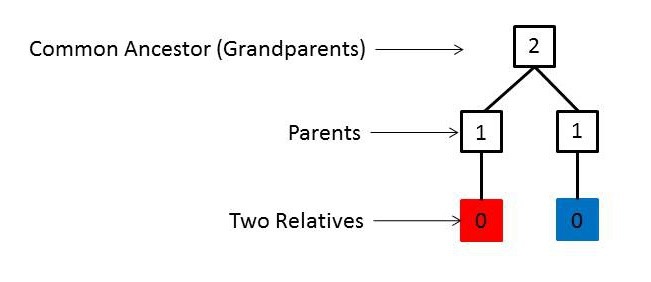
Note that, in between each individual and the common ancestor, there is one non-common ancestor (each person’s parent). So you could say that first cousins have two links in their chain, or that first cousins have one “intermediate” ancestor.
For more distant cousins, you simply extend the chains. Second cousins, for example, have three links in their chains, or two intermediate ancestors:
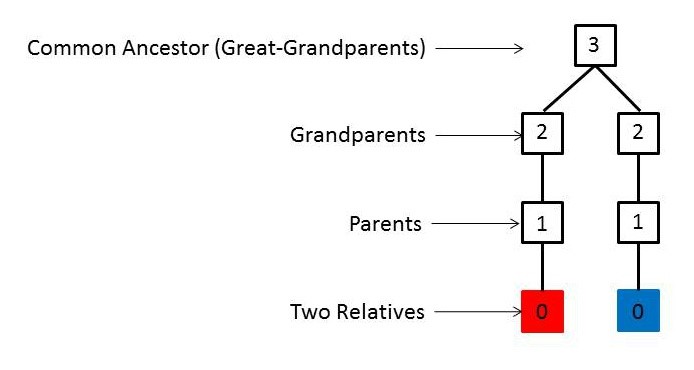
And third cousins have four links and three intermediate ancestors:
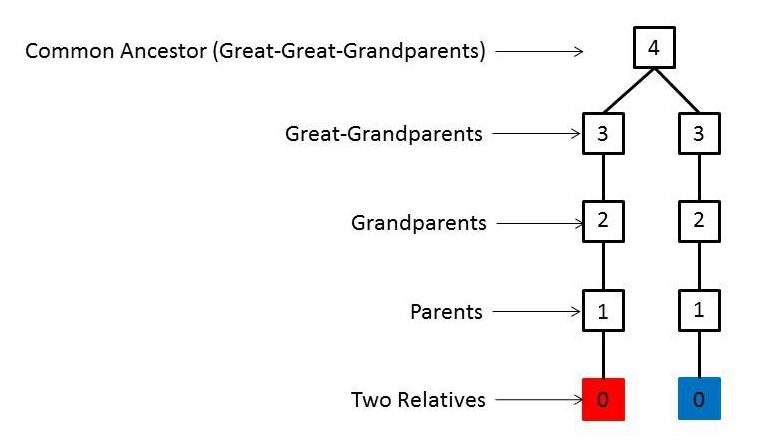
This is why, by the way, people often get really vague about relationships beyond second cousins. Families in our society usually only associate regularly when common ancestors are still alive. Great-great-grandparents are usually gone by the time children are old enough to start recognizing relatives, so they don’t associate with third cousins often.
So these types of cousin are pretty straightforward. What about the “once-removed” thing? That comes into play when the chains are different lengths. As before, we’ll start with the circumstance where the chains are the shortest. When one person’s chain is one link long (i.e., the common ancestor is his or her parent), and the other person’s is two links long (a grandparent), then one relative is an uncle or aunt, and the other is a nephew or niece. (This is one of the few circumstances in our kinship terminology where there is no gender-neutral term.)
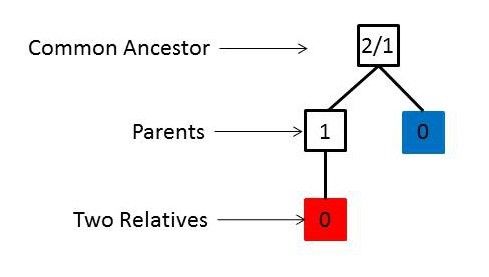
If we move the common ancestor back a generation, we find a circumstance where that ancestor is the grandparent of one person, and the great-grandparent of the other.
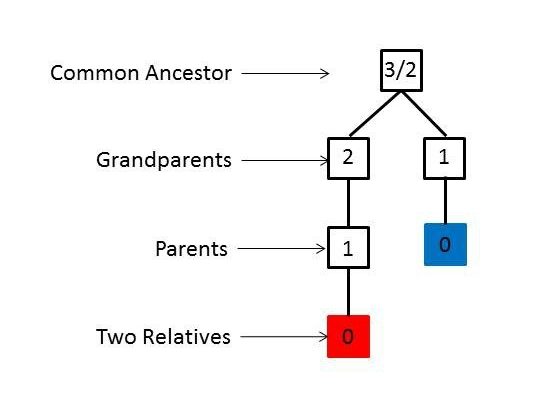
In these circumstances, we look first at the shortest chain. It has only one intermediate ancestor, so these two individuals are first cousins. Now, we look at the difference between the two chains. How many links must be removed from the longer to make it the same length as the shorter? In this case, we must remove one link, so these two individuals are “once-removed,” or more completely “first cousins, once-removed.”
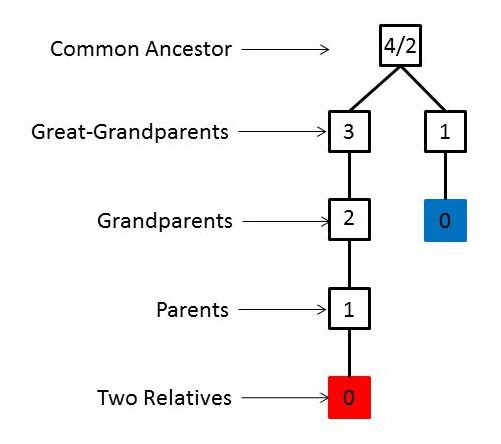
In this example, the shoter chain still has only one intermediate ancestor, so these are first cousins again. But this time, we must remove two links from the longer chain to make it equal the shorter chain. So these are “first cousins, twice-removed.”
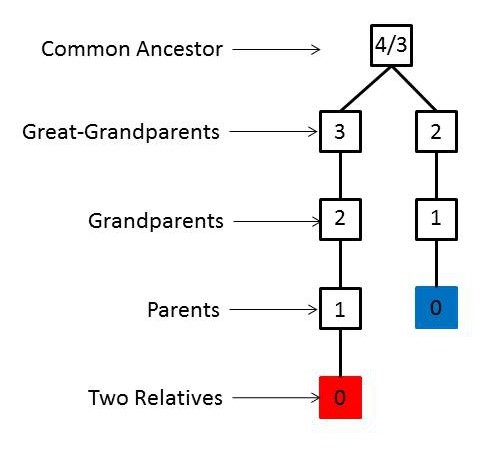
Here, the shorter chain now has two intermediate ancestors, so these are second cousins. The longer chain is one link longer, so they are “second cousins, once removed.”
Similar principles can be be applied to great-aunts and great-uncles. A great-aunt is an aunt, once-removed, and a great-great-aunt is twice-removed, and so on.
That’s really all there is to the cousin kinship terminology. How many intermediate ancestors on the shorter chain, and how many more links on the longer one. Couldn’t be simpler!